China’s steel industry is changing how engineers approach lighter, safer structures. The question is not simply how to use less steel. It is how to place every kilogram where it creates the greatest structural value. This introduction explores how to reduce structural weight using steel without sacrificing strength, stability, fire resistance, or construction quality.
Structural engineer William F. Baker has often expressed this design principle: “The best structure is the one that does the most with the least.” His words reflect a practical reality. A lighter frame can reduce foundation loads, transportation demand, crane time, and embodied carbon. However, weight reduction must begin with engineering judgment. High-strength steel, optimized plate thickness, tapered members, hollow sections, and efficient bracing can improve performance. Yet these solutions are not automatically better. A thinner column may increase buckling risk. A complex connection may save material but slow fabrication. A lightweight floor system may create vibration concerns.
The most reliable process combines digital modeling with workshop experience. Engineers can compare load paths, connection behavior, erection sequences, and maintenance access before production begins. In a Chinese manufacturing environment, material availability and welding capability also influence the final result. Small design choices matter. A refined gusset plate, a shorter load path, or a better-aligned column can remove unnecessary steel. Still, no method is perfect. Weight targets should be reviewed against safety margins, durability, cost, and real construction conditions. The strongest design is not always the lightest one. It is the one that remains dependable after analysis becomes reality.
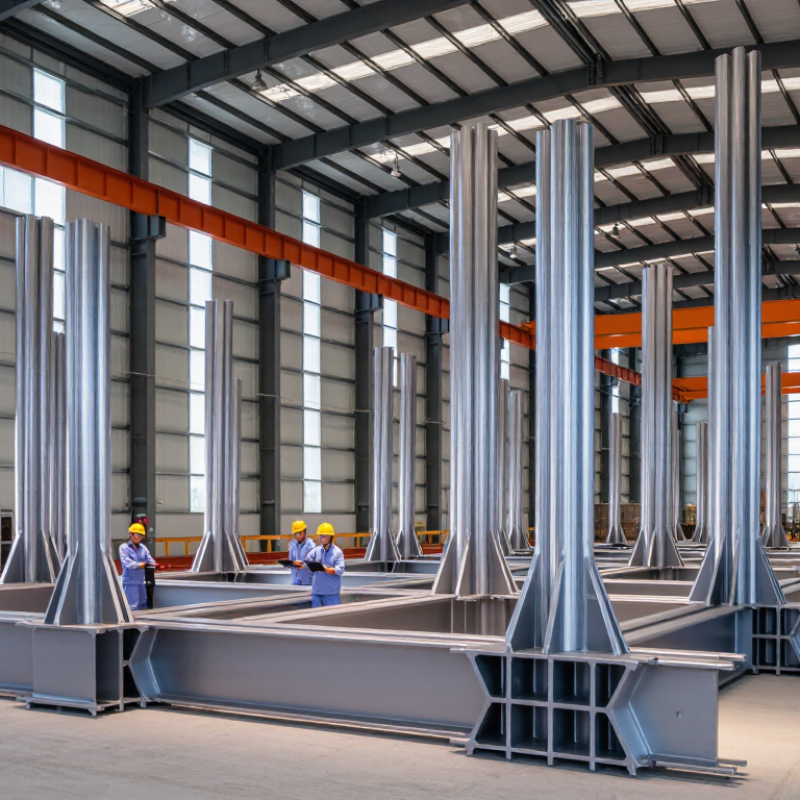
Upgrading from Q355 to Q460 or Q690 steel can reduce structural weight significantly. Yield strength rises from 355 MPa to 460–690 MPa. This allows smaller plates, lighter beams, and more compact columns. In practical design reviews, engineers often find savings around 10–25 percent. The actual reduction depends on load conditions, member length, and connection design.
Strength alone does not control every structure. Slender columns may still fail through buckling before reaching yield strength. Deflection, vibration, fatigue, and fire resistance also require careful checking. A thinner plate can lower weight, but it may increase welding distortion or local instability. That trade-off is easy to underestimate.
Weldability needs special attention, especially with Q690 steel. Higher-strength grades can require controlled heat input, suitable consumables, and preheating. The heat-affected zone may lose performance if procedures are poorly managed. Mill certificates, impact-test results, weld procedure qualifications, and site inspections should support every project. Small details matter.
A common mistake is selecting Q690 for all members without checking connection capacity. Bolts, gusset plates, and welds may then become the heaviest parts. Cost can also rise because fabrication becomes less forgiving. The best design usually combines grades instead of using one grade everywhere. That approach is more efficient, but it demands disciplined engineering judgment.
China Best Steel: How to Reduce Structural Weight?
Optimize member geometry before reducing material grades. A deeper I-section can improve bending efficiency, while tapered flanges or hollow sections may reduce steel area by 20–40% where stability allows. The saving is not automatic. Engineers must check buckling length, lateral-torsional stability, local slenderness, vibration, fire resistance, and connection forces. A small profile change can create a large fabrication problem. It happens.
The 2024 World Steel in Figures report recorded about 1.89 billion tonnes of crude steel production in 2023. The International Energy Agency estimates that steel production creates roughly 2.6 gigatonnes of direct carbon dioxide emissions each year. Efficient geometry therefore matters, but design safety remains non-negotiable. Eurocode and national steel design standards require resistance and serviceability checks, not simple weight comparisons. A lighter member may also increase deflection or complicate erection tolerances.
Tips: Start with a stability map for every member. Compare compact, non-compact, and slender sections. Use second-order analysis for compression frames. Detail connections before approving final sizes. Leave inspection access around stiffeners and bolts. Recheck the model after architectural changes. A 30% area reduction looks attractive, yet one overlooked restraint can erase the benefit.
Comparison of baseline and optimized steel cross-sectional areas for typical compression and bending members. The optimized cases show 20–40% steel-area reductions where stability, strength, and serviceability requirements permit.
Steel weight is approximately proportional to cross-sectional area when member length and steel density remain unchanged. Final reductions must be verified for buckling, deflection, connection design, fatigue, and applicable structural codes.
Reducing structural weight starts with controlling buckling, not simply choosing thinner steel plates. The 2024 World Steel in Figures report records China’s crude steel production at about 1.019 billion tonnes in 2023. At this scale, small design savings matter. Yet slender members can lose strength quickly when their effective length increases. Engineers should check KL/r for global buckling and b/t for local plate buckling.
Stiffeners shorten the unsupported width of webs and flanges. They can also improve post-buckling behavior when detailed correctly. However, a stiffener does not automatically reduce the member’s global slenderness ratio. Bracing location, connection rigidity, and effective length still require verification. GB 50017 controls structural steel design in China, while GB/T standards commonly define steel products and material grades. Treating “GB/T limits” as one universal slenderness table is a risky simplification.
The IEA’s Iron and Steel Technology Roadmap estimates that steelmaking produces roughly 7–9% of global carbon dioxide emissions. Weight reduction therefore has both engineering and environmental value. A practical workflow checks the unbraced length, calculates KL/r, then sizes stiffeners for shear, local buckling, and connection forces. The first model is rarely right. Too many stiffeners add welding, residual stress, and inspection points. A lighter frame is not better if its load path becomes unclear. Final decisions should compare calculation results with fabrication tolerances and site conditions.
Reducing structural weight starts with the load path, not thinner steel. Topology optimization removes low-stress zones from beams, brackets, and transfer frames. Finite-element studies in the Journal of Constructional Steel Research often report material reductions of 10–25% when geometry and restraints are modeled together. The target is practical, but not automatic.
Connection optimization can deliver similar gains. Designers can refine bolt spacing, end-plate thickness, weld length, and stiffener placement. A 6-metre beam may need fewer stiffeners after local buckling checks are improved. The American Institute of Steel Construction reports that connection design can represent a significant share of steelwork cost and fabrication effort. Small detailing changes can therefore reduce both weight and workshop complexity.
Keep the load path clear. Always.
The World Steel Association reports that steelmaking produces roughly 7–9% of global carbon dioxide emissions, so every avoided kilogram matters. Yet optimization must include fire resistance, fatigue, corrosion allowance, erection tolerances, and future alterations. Over-optimized models can fail when real connections are less rigid than assumed. I have seen efficient layouts become expensive after site access was ignored. A 10–25% reduction should remain a verified design range, not a marketing promise. Independent checking, physical connection reviews, and sensitivity testing make the result more reliable.
Yield strength can rise from 355 MPa to 460–690 MPa. This may allow thinner plates, lighter beams, and smaller columns. Typical savings may reach 10–25 percent. Actual results vary.
No. Buckling, deflection, vibration, fatigue, and fire resistance still control design. A slender column may buckle before reaching its yield strength. Strength alone is not enough.
Check global buckling using effective length and slenderness. Check local buckling using plate width-to-thickness ratios. Also review fabrication tolerances and support conditions. Thin is not automatically efficient.
No. Stiffeners reduce unsupported web or flange widths. They do not automatically shorten global effective length. Bracing positions, connection rigidity, and load paths need verification. The first model may be wrong.
Extra stiffeners increase welding, residual stress, inspection points, and fabrication time. They can complicate the load path. More steel does not always mean better performance.
Welding may require controlled heat input, suitable consumables, and preheating. Poor procedures can weaken the heat-affected zone. Weld procedure qualifications and site inspections should support the work. Small details matter.
Usually not. A mixed-grade design may be more efficient. Connections can become heavier when members use very high-strength steel. Bolts, gusset plates, and welds still need capacity checks. Uniform selection can be wasteful.
Review material certificates, impact-test results, and qualified welding procedures. Inspect completed joints and compare results with design assumptions. Fabrication quality can change the real performance. Do not rely on calculations alone.
Less steel can reduce transport weight and material-related emissions. Steel production creates substantial global carbon dioxide emissions. However, higher-strength grades may cost more to fabricate. A lighter frame is not always cheaper.
Reducing structural weight begins with understanding the loads acting on a building or industrial structure. Dead load can account for 40–60% of the total load, so reducing the weight of steel members may create significant savings throughout the design. One effective approach is to select higher-strength steel, such as grades with yield strengths of 460–690 MPa, when the project requirements and design standards permit. This can provide the required capacity with less material.
A practical guide on how to reduce structural weight using steel should also address member geometry, stability, and connections. By optimizing cross-sections, engineers may reduce steel area by 20–40% where strength and stability remain adequate. Stiffeners can help control buckling and keep slenderness ratios within applicable GB/T limits. In addition, topology optimization and efficient connection design can reduce unnecessary material, with a potential overall weight reduction of 10–25%. These measures should always be verified through detailed structural analysis and safe engineering practice.
Terra Steel